270 Park Avenue
Year
2019

Space Syntax supported Foster + Partners in the design of the new global headquarters for JP Morgan Chase & Co at 270 Park Avenue in Midtown Manhattan.
The design of the 60-storey tower was conceived to redefine the workplace experience by offering high-quality amenities within an innovative environment that encourages informal encounters, social interaction and communication. The aim in doing so is to enhance employee wellbeing and drive operational performance.
Space Syntax was appointed to providestrategic design advice on spatial layout and user activity patterns both outside and inside the building. Our scope covered the new public space on Madison Avenue, the entrance lobby areas and the ‘Exchange’: four levels that include the lift transfer areas, a multi-level food hall and conference facilities.
With a building capacity of up to 14,000 employees, the study included a comprehensive analysis of movement patterns and space utilisation. These insights informed the design of circulation areas to ensure they accommodate key desire lines, anticipatedemand and support different types of workplace activity.
Our analysis began with an evaluation of the public realm and lobby design. Using existing urban movement data, turnstile records and projected trip generation for the new building, we assessed the key approaches to the building. We also established arrival/departure profiles for both employees and visitors and analysed the entrance demand during peak periods. Our insights created an early understanding of the building’s likely impactson surrounding movement patterns and helped make key decisions regarding the number and location of principal building entrances.
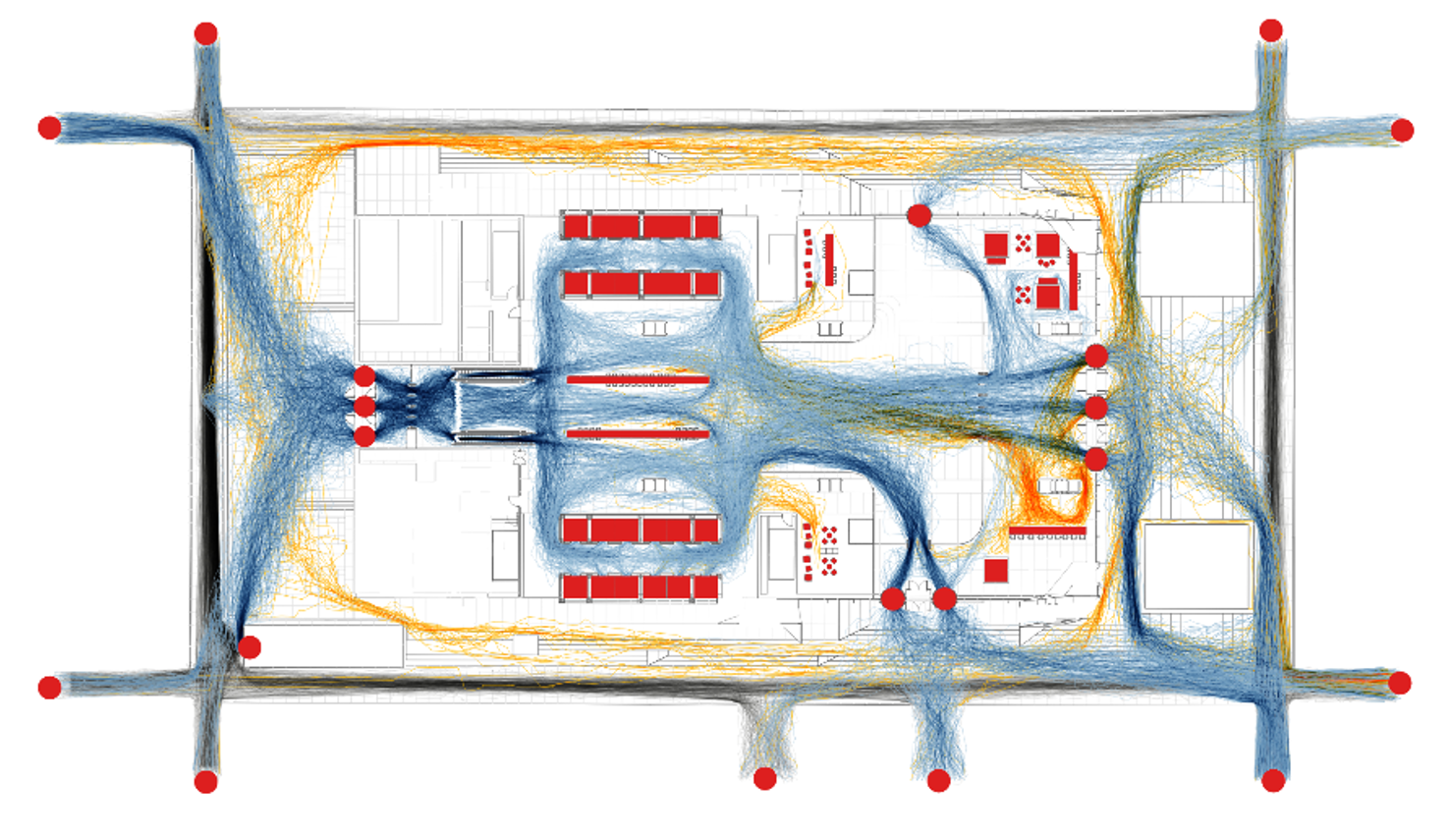
For the Exchange – the four levels that include the lift transfer areas, a multi-level food hall and conference facilities – we undertook spatial layout analysis of user wayfinding patterns, which informed the early-stage designs. An agent-based model was constructed for the public realm, lobby and the Exchange to simulate user movement and identify key desire lines, activity levels and potential congestion hotspots.
The outputs of this work included a detailed assessment of queuing capacity within the main circulation areas, including at entrances, security barriers, lift lobbies, transfer zones, escalators and reception areas. Based on the analysis, recommendations for design optimisations were provided to help the design team create a work environment that offers a high-quality user experience.
Working closely with the design team, our analysis revealed opportunities and provided recommendations for layout and programme optimisation. This included feedback on the legibility of the circulation areas, refinement of the location of key functions such as security and catering, advice on the placement of interior design fixtures and optimisation of the location and design of vertical circulation elements, including internal staircases.
We also advised on the spatial layout and programmatic design of workspace areas that need to be optimised to accommodate a wide variety of uses from quiet, focused work zones to informal meeting areas fostering unplanned encounters and social interactions.
Our insights helped shape a workplace design that brings people together while supporting communication, productivity and wellbeing.