Riyadh, Desert Park Concept Plan
Year
2023
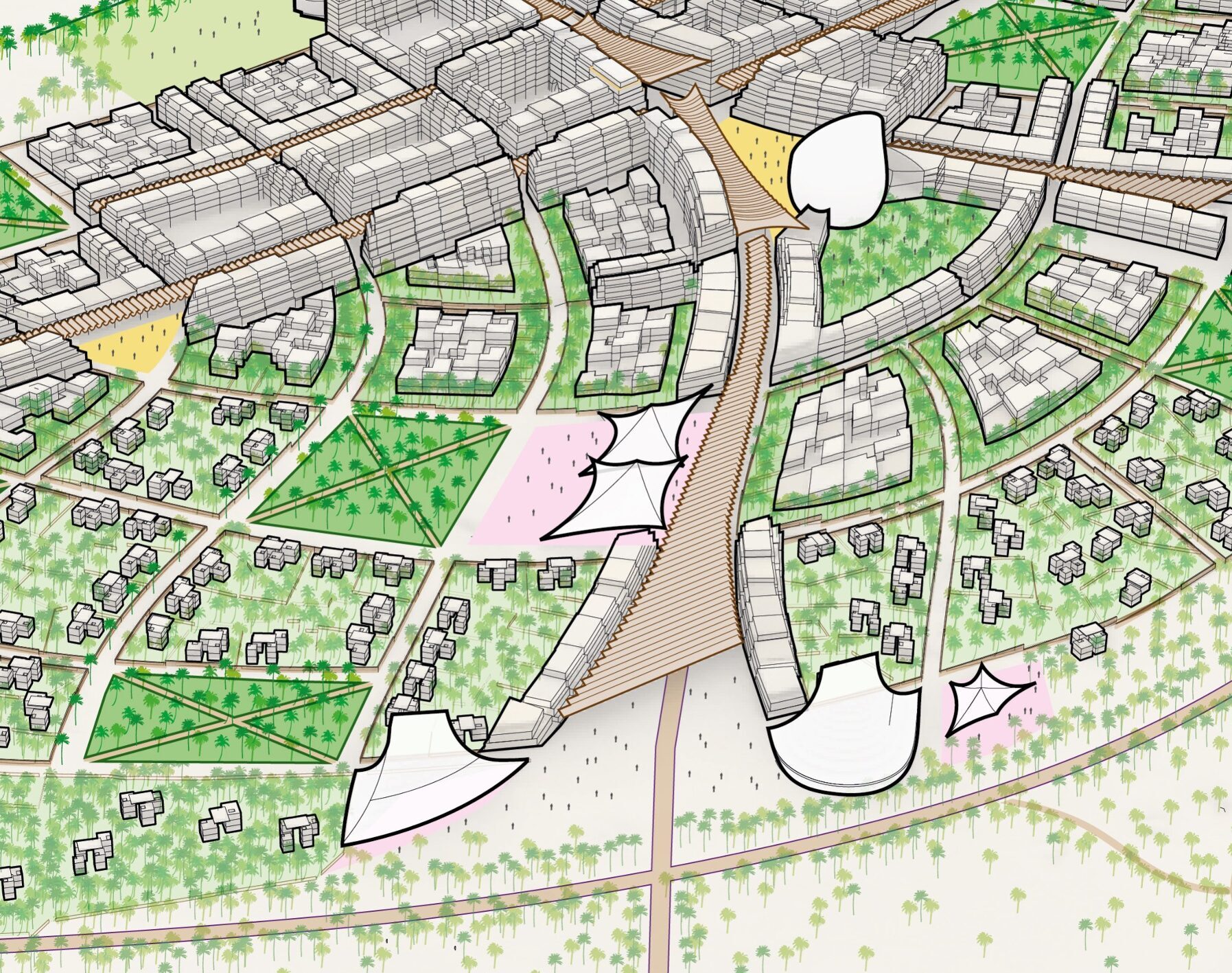
The Desert Park presents a powerful opportunity to define what it means to create a truly life-centric park and urban plan – a place designed first and foremost around people, their wellbeing and their relationship with nature.
Rather than shaping places around outdated models of car-dominance or unproven technological fixes, this project follows an evidence-based approach. It prioritises walkability, comfort, creativity, interaction and health, all within a framework that respects and regenerates the surrounding landscape.
At the edge of Riyadh, the Desert Park becomes a testbed for climate-resilient, inclusive design – where human behaviour and ecological performance are treated as interconnected systems.
The opportunity lies in creating a park that doesn’t just serve as a green space, but as a functioning urban system: a place that produces clean energy, supports circular economies and fosters activities that only people can undertake: connecting, innovating and thriving.
Space Syntax led the generative design and urban strategy for the Desert Park. The team used a data-led process to translate high-level ambitions into designs, optimising these to produce positive long-term outcomes.
We approached the site as a network of interrelated systems — mobility, land use, energy, water, ecology — and designed an urban plan that supports compact, walkable neighbourhoods stitched together by a cool, shaded public realm.
Connectivity was key: we used behavioural and spatial analysis to ensure natural movement flows that support both vibrancy and moments of retreat. Importantly, we applied circular design principles across every scale, from street layout to resource flows.
Our work included strategic input on urban form and massing to passively reduce energy demand, embedding local cultural references into the built environment and using modern interpretations of vernacular techniques to enhance thermal comfort.
By combining scientific modelling with creative placemaking, we helped shape a park that is as striking and sensitive as it is liveable – balancing innovation with tradition and ecology with human experience.
The outcome is a life-centric park and urban plan that puts human and environmental wellbeing at its core.
The Desert Park is a place where everyday activity – walking, meeting, creating, relaxing – happens in comfort, under deep shade and within reach of nature.
A fine-grained network of vibrant streets and public spaces invites people to be active, healthy and socially connected. Its compact development footprint protects the surrounding ecology while enabling deep interaction with the landscape.
The park functions as a closed-loop system that generates clean energy, recycles resources and fosters innovation. It reflects Riyadh’s cultural evolution while setting a global standard for sustainable, life-centred urbanism.
Further information
Space Syntax Studio page
Details of our work leading the planning and design of buildings and urban areas.

